


Our Complete Homeowner’s Guide to Energy-Efficient Windows in 2026
Western Washington weather puts real pressure on your windows. A wet climate, a long heating season, and wide temperature swings mean you need windows that can perform in all kinds of conditions.
Installing new energy-efficient windows helps you address these climate concerns. They can reduce heat transfer, block moisture, and make rooms consistently comfortable rather than just technically heated. But energy-efficient windows do more than protect you and your home from the weather. The payoff shows up on your utility bills and in how your home feels on a February morning.
At Lake Washington Windows and Doors, we have spent nearly two decades helping homeowners make this upgrade. This guide covers what makes a window energy-efficient, how to evaluate your options, what to look for specifically in the Pacific Northwest, and explains how homeowners can save on energy-efficient window upgrades.
What Are Energy-Efficient Windows?
A window qualifies as energy-efficient when it meets independently verified performance standards for heat transfer, solar control, and air leakage.
The benchmark for that verification is ENERGY STAR certification, a federal program administered by the U.S. Environmental Protection Agency. To earn the ENERGY STAR label, a window must be tested by a third party, rated by the National Fenestration Rating Council (NFRC), and confirmed to meet the efficient certification requirements for the climate zone where it will be installed.
What that means in practice is that the performance numbers on the label are not self-reported. They come from independent testing conducted using a standardized methodology, which makes them a reliable way to compare products across every manufacturer on the market. When you are evaluating windows from different brands, the NFRC label gives you a common language for doing that comparison.
Why Replace Inefficient Windows
Old windows create a predictable set of problems, and energy-efficient windows are engineered to solve each one. The table below shows what homeowners typically give up by keeping inefficient exterior windows, and what they gain by replacing them.
| Old & Inefficient Windows | Energy-Efficient Windows |
| Drafts and cold spots: Even when the heat is running, old windows create cold zones along the glass and frame that make rooms feel uncomfortable. | Consistent indoor temperatures: Insulated glass systems and tight frames eliminate cold spots and keep room temperatures stable regardless of outdoor conditions. |
| Condensation and moisture: Temperature differentials between interior air and cold glass cause moisture to collect on the glass surface and sill, leading to mold, rot, and water damage over time. | Condensation resistance: Modern glass systems and warm-edge spacers minimize the temperature differential at the glass surface, reducing moisture buildup and protecting the surrounding wall assembly. |
| High heating and cooling costs: Heat escapes freely through single-pane or poorly sealed glass, causing energy loss that forces your HVAC system to run longer and harder than it should. | Lower energy bills: ENERGY STAR certified windows reduce annual energy costs by an average of 12%, with the largest savings for homeowners replacing single-pane glass. |
| UV damage: Clear glass allows ultraviolet light to pass freely into your home, fading flooring, furniture, and window treatments over time. | UV protection: Low-E coatings filter out the majority of damaging ultraviolet light while still allowing natural daylight through, protecting interior finishes without darkening the room. |
| Noise infiltration: Single-pane glass and poor seals transmit sound readily, whether from street traffic, neighbors, or weather. | Sound reduction: Multi-pane glass units with dissimilar pane thicknesses and gas fills significantly reduce the transmission of outside noise into your living space. |
| Decreased home value: Visibly aging windows signal inefficiency to prospective buyers. In a market where energy performance is increasingly a purchasing consideration, old windows are a liability. | Increased home value: New vinyl windows carry a national average resale return of approximately 73%, according to Zillow, making window replacement one of the stronger home improvement investments for long-term equity. |
How Much Money Can Energy-Efficient Windows Save Washington Homeowners?
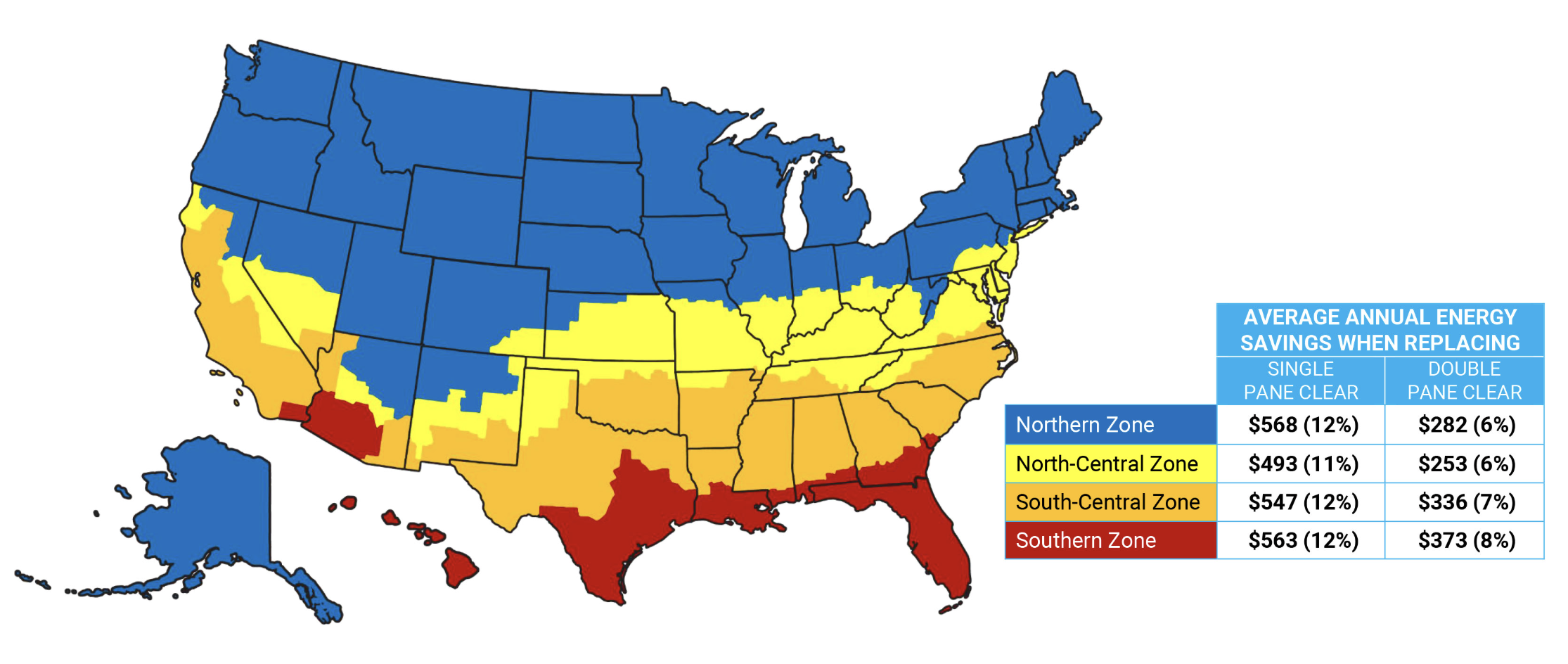
The answer depends on what you are replacing. Western Washington sits in the Northern zone, shown in blue on the map above. The combination of a long heating season and cold, wet winters gives energy-efficient windows more months per year to deliver savings than almost anywhere else in the country.
According to 2023 research by D+R International, Northern zone homeowners who upgrade to ENERGY STAR-certified windows can expect the following average annual savings:
|
Windows Replaced |
Annual Savings |
30-Year Savings |
50-Year Savings |
|
Replacing single-pane windows |
$568 |
$17,040 |
$28,400 |
|
Replacing double-pane windows |
$282 |
$8,460 |
$14,100 |
These figures do not account for the reduced load on your heating and cooling systems. Energy-efficient windows help your home use less energy overall, cutting HVAC workload by 15% to 30%, which can extend the service life of your furnace and air conditioning by several years and reduce maintenance costs in the process.
Energy savings aside, window replacements in 2026 recoup an average of 50% to 75% of their cost in immediate home resale value. For a homeowner weighing the full financial picture, saving money on utilities from day one while building long-term equity makes replacement one of the strongest investments available to a homeowner.
Factors That Influence a Window’s Energy Efficiency
Every certified energy-efficient window carries a label from the National Fenestration Rating Council that shows four performance metrics. These numbers are how you compare products without relying on marketing language.
The ENERGY STAR program uses those same metrics to set minimum performance requirements by climate zone. Western Washington falls in the Northern zone, which carries the highest U-factor requirement in the country. That reflects the region’s heating-dominant climate: long, wet winters where the priority is to reduce heat loss at every possible point in the window assembly.
Understanding what each metric measures will help you read that label and evaluate why certain products perform better in Pacific Northwest conditions than others.
|
Climate Zone |
U-Factor Requirement |
Solar Heat Gain Coefficient Requirement |
Air Leakage |
|
Northern |
0.30 or lower |
Any |
0.3 cfm/sq ft* |
|
North-Central |
0.32 or lower |
0.40 or lower |
0.3 cfm/sq ft |
|
South-Central |
0.35 or lower |
0.30 or lower |
0.3 cfm/sq ft |
|
Southern |
0.60 or lower |
0.27 or lower |
0.3 cfm/sq ft |
*cubic feet per minute per square foot measures how much air flows through the window
U-Factor
For homeowners whose primary concern is keeping heat inside through a long, wet winter, U-factor is the single most important number on the label. It measures how well the window assembly can minimize heat transfer between the inside and outside of your home. The lower the number, the better the window insulates. Western Washington sits in ENERGY STAR’s Northern climate zone, which requires a U-factor of 0.30 or lower.
Solar Heat Gain Coefficient
Solar heat gain coefficient (SHGC) measures how much of the sun’s heat the window allows through the glass. A lower SHGC blocks more solar heat, which is the priority in warmer and hot climates where cooling costs dominate. In the Pacific Northwest, the Northern zone has no SHGC requirement because passive solar gain during winter can actually reduce heating costs and energy use. The right SHGC depends on your home’s orientation, exterior shading, and how much direct sunlight each window receives.
Visible Transmittance
Visible transmittance (VT) measures how much natural daylight the window allows through the glass. A higher VT means more light passes through. Because additional glass coatings tend to reduce VT, it is worth thinking about the role natural light plays in each room when choosing between glass packages.
Air Leakage
Air leakage (AL) measures how much air passes through the window assembly under pressure. A lower AL rating means a tighter seal. This matters most for operable window types, where the interface between the moving sash and the frame is the most vulnerable point in the assembly for air loss.
The Anatomy of an Energy-Efficient Window
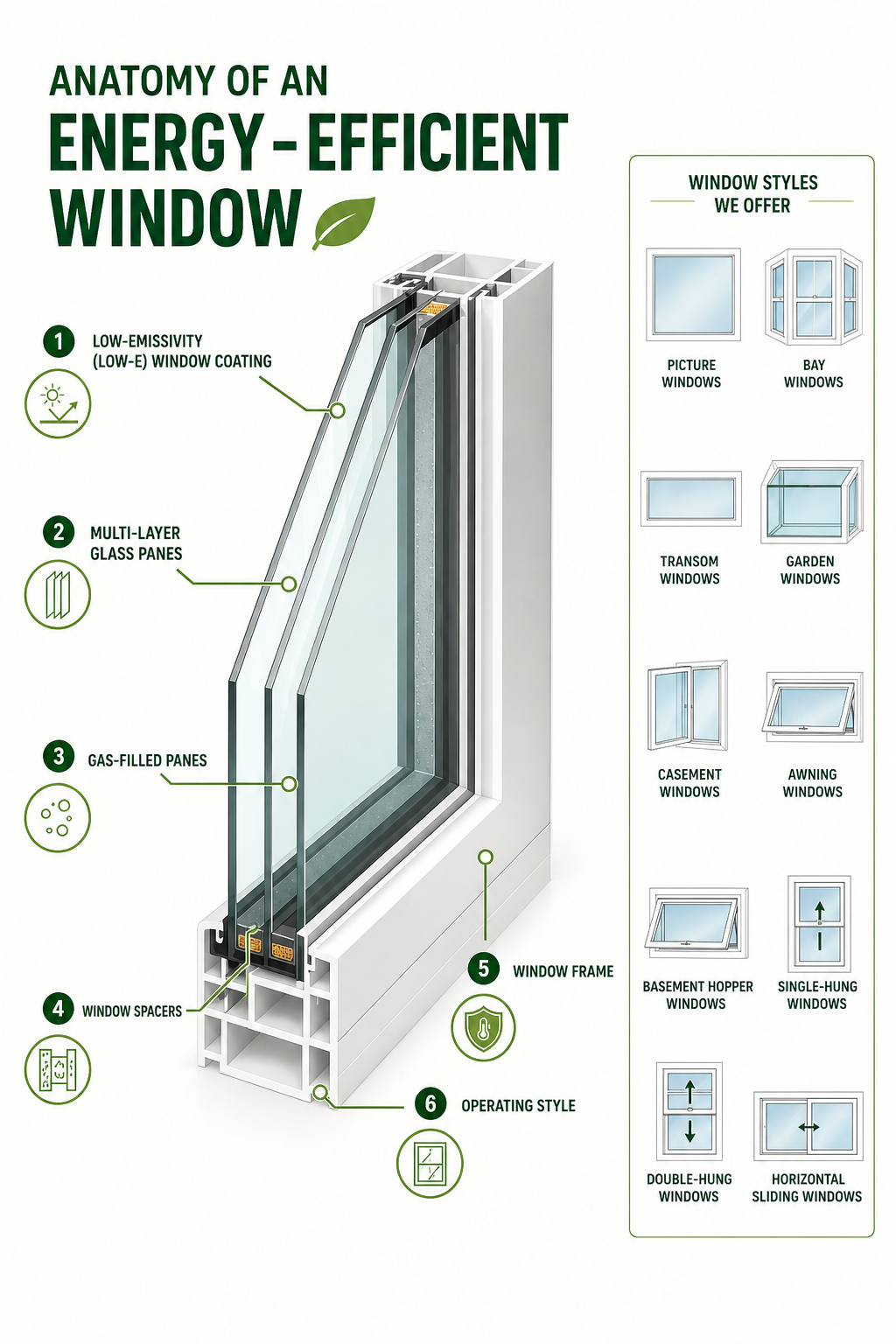
Each component of an energy-efficient window utilizes various energy-saving technologies to reduce the effects of air leakage, convection currents, and solar radiation.
Low Emissivity (Low-E) Window Coating
A window’s emissivity refers to its ability to reflect and radiate heat rather than absorb it. Low-E window coatings are microscopically thin layers of transparent metal or metallic oxide between the window panes to reflect solar energy.
Low-E coating can increase a window’s energy performance by as much as 40 to 70%. It can be applied to manipulate heat transfer depending on the surrounding climate by reflecting solar energy away from your home in hot climates or keeping it from leaving once it has passed through your windows in cooler ones.
Multi-Layer Glass Panes
Some time ago, manufacturers discovered that window insulation could be significantly improved by sandwiching multiple layers of glass together rather than using a single pane. These multi-layer window designs create air pockets between each pane. Those pockets are then sealed to prevent air from entering or exiting the space.
Double-pane windows utilize two panes of glass with a sealed compartment between them. The additional pane significantly reduces the UV rays that can pass through the window, which keeps your home cooler in the summer. Double-pane windows also prevent the warm air in your home from dissipating, which conserves energy during cooler months.
Triple-pane windows utilize a third layer of glass to create two separate sealed compartments. This additional layer of glass can stop up to 95% of all unwanted UV rays. Generally, homeowners choose triple-pane windows when enhanced energy performance is their primary objective, as they cost nearly twice as much as double-pane windows.
Gas-Filled Panes
Manufacturers then discovered that inert gases like krypton and argon were much better insulators than air due to their ability to slow the movement of hot and cold air significantly, stopping radiant heat from passing through the window and reducing heat transfer.
With these inert gases serving as additional insulation layers, double-pane windows can provide three layers of protection, while triple-pane windows can provide five protective layers.
Window Frame
The frame accounts for roughly 20% of a window unit by area, but its contribution to your home’s energy efficiency is significant. A poorly insulating frame creates a direct pathway for heat to escape in winter and enter in summer, regardless of how well the glass unit performs. Two frame materials stand out in the Pacific Northwest: vinyl and fiberglass. Both resist the moisture, temperature swings, and UV exposure that Western Washington delivers year-round, and both insulate far better than aluminum or older wood frames. The differences are in durability, thermal expansion behavior, and price.
Fiberglass frames expand and contract at nearly the same rate as the glass they hold, which keeps seals tight and prevents air leakage as the frame ages. Vinyl frames are highly efficient and durable, available at a lower price point, with some expansion and contraction that modern weatherstripping is designed to accommodate. Both are sound choices for Pacific Northwest conditions; the right one depends on your performance goals and budget.
Window Spacers
Non-metal and metal hybrid window spacers installed between window panes insulate the pane edges to improve insulation, prevent condensation, and further reduce heat loss at the edges of the glass unit, where it is most vulnerable.
Operating Style
Not all window types offer the same level of energy efficiency, and the difference comes down to how well each style seals when closed.
Fixed windows, such as picture windows, are the most efficient because they have no operable parts and no moving seal to degrade over time. Among operable styles, casement windows and awning windows seal the most tightly, using a compression mechanism similar to a door that presses the sash firmly against the frame. A double-hung window, by contrast, relies on a sliding seal between the sashes and the frame, which is somewhat less airtight by design, though modern weatherstripping has narrowed that gap considerably. Sliding windows work on the same principle.
Energy-Efficient Windows at Lake Washington Windows and Doors
At Lake Washington Windows and Doors, we offer the following window styles for exterior windows and other openings throughout your home:
Our curated lineup of window products is chosen for their energy performance in Pacific Northwest conditions, their warranty coverage, and their long-term track record. Each is designed for installation in an existing home and installed by our own team, backed by a Lifetime Installation Guarantee.
Milgard C700 Series Fiberglass Window Frames
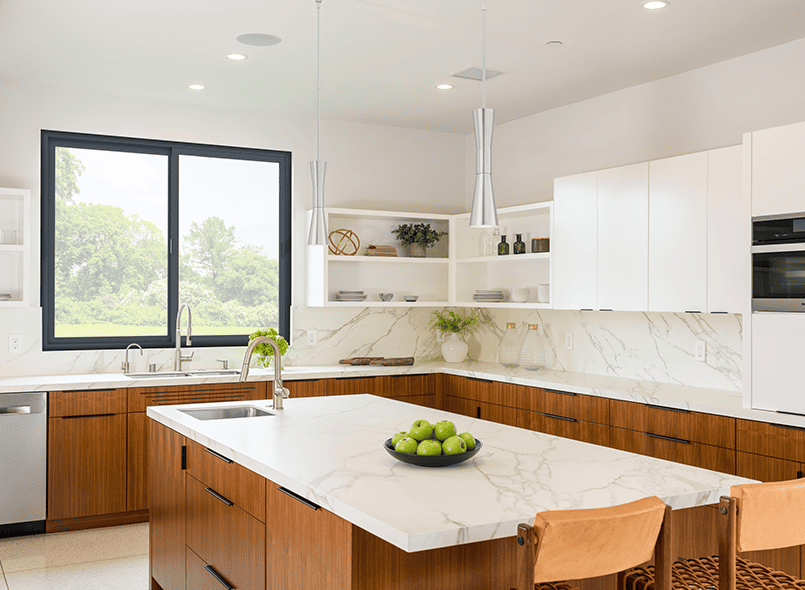
The Milgard C700 Series is the fiberglass window in our lineup, and as a Platinum-level Milgard dealer, we have more experience installing it across Western Washington than most companies in the region. Fiberglass frames expand and contract at nearly the same rate as glass, keeping seals tighter over time and maintaining energy performance longer than vinyl or aluminum alternatives. The C700 comes standard with SunCoat Low-E2 glass and meets ENERGY STAR requirements for the Pacific Northwest climate zone.
Anlin Del Mar & Del Mar Expanded Vinyl Windows

The Anlin Del Mar series is our flagship vinyl window and the only product in our lineup available exclusively through Lake Washington Windows and Doors in Western Washington. Both the Del Mar and Del Mar Expanded are built on the same high-performance platform and exceed ENERGY STAR standards for the Northern zone across every performance category. The Del Mar Expanded features a slimmer frame profile that puts more glass in the opening, making it the right choice for homeowners who want maximum natural light alongside premium energy performance.
Anlin Coronado Vinyl Windows

The Coronado Series is Anlin’s standard vinyl window line and a proven performer in Pacific Northwest conditions. It shares the core insulation technology found across the Anlin lineup and meets ENERGY STAR certification requirements for the Northern zone. For homeowners who want reliable, independently tested vinyl performance with Anlin’s full warranty coverage at a more accessible price point, the Coronado is a solid choice.
WinDor 2750 Bi-Fold Windows
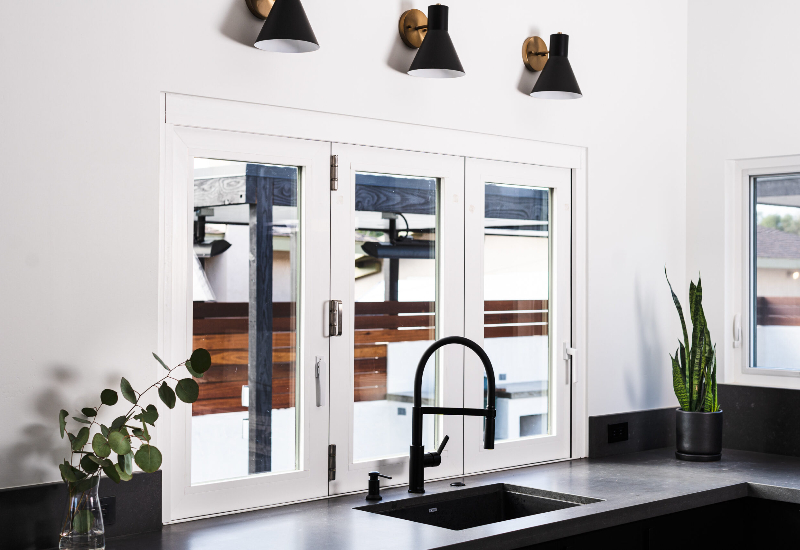
The WinDor 2750 is a different category of window entirely. The 2750 is a folding system that opens a full wall to create a direct connection between your interior living space and the outdoors. Patios, decks, and entertainment areas are a natural fit. It is built with aluminum-reinforced vinyl construction that combines structural strength with the thermal efficiency vinyl provides, and uses Cardinal 366 glass and argon gas to deliver energy performance that holds up in a fully operable wall system.
Savings Opportunities for Western Washington Homeowners
While the federal tax credit that offset the cost of replacement windows expired at the close of 2025, meaningful savings opportunities still exist for Western Washington homeowners.
Puget Sound Energy’s window rebate program pays $50 to $100 per replacement window, depending on the thermal performance of the product installed, with up to $200 per window for income-qualified customers through the Efficiency Boost program. Snohomish County PUD, Tacoma Power, and many of Washington’s other public utility districts run comparable programs tied to their electric conservation budgets.
Replacement window dealers also run seasonal promotions throughout the year, and most offer financing options that make it possible to move forward without a large upfront payment. Ask your consultant what is currently available when you schedule your consultation.
Why Professional Installation Matters for Energy-Efficient Windows
The best window on the market is only as good as the installation behind it. A poorly installed window creates gaps, air pathways, and moisture entry points that no glass package or frame material can compensate for. You can spend more on a high-performance product and end up with worse results than a cheaper window that was set correctly, because the window itself is only half the equation.
This matters more in Western Washington than most places. A wet climate is unforgiving of installation shortcuts. Flashing that was not fully integrated, a rough opening that was not properly sealed, or a drainage plane that was cut incorrectly are not problems that stay small. Water finds those gaps, works its way into the wall assembly, and causes damage that has nothing to do with the quality of the window you chose. By the time it shows up as a stain or a soft sill, the underlying problem has usually been there for a while.
The efficiency ratings that make a window worth buying are tested and verified before the product ever leaves the factory. Protecting those ratings in your home is the installer’s job.
At Lake Washington Windows and Doors, every installation is performed under our proprietary Leak Armor system: a commercial-grade method using multiple layers of flashing, pans, and sealants engineered specifically for Pacific Northwest conditions. It is included with every project at no additional cost and backed by a Lifetime Installation Guarantee, because a window that performs as designed for the life of the home is the only kind worth installing.
Ready to Replace Your Windows? Here’s How to Get Started
Energy-efficient windows are one of the most impactful upgrades a Western Washington homeowner can make, improving comfort, reducing energy costs, protecting against moisture, and adding lasting value to the home. The technology behind them, from Low-E coatings and gas-filled panes to frame materials and installation quality, works as a system. Getting the most out of that system means choosing the right product for your climate, pairing it with a qualified installer, and taking advantage of the utility rebates and financing options available to you right now.
At Lake Washington Windows and Doors, we offer complimentary in-home consultations for homeowners across King, Pierce, Southern Snohomish, and Kitsap Counties. Request yours today, and one of our consultants will walk you through your options, confirm which products qualify for available PSE rebates, and provide a detailed estimate before you commit to anything.
FAQs – Energy Efficient Windows
Do energy-efficient windows really make a difference?
Yes. According to the U.S. Department of Energy, heat gain and loss through windows are responsible for 25% to 30% of residential heating and cooling energy use. ENERGY STAR® certified windows can reduce energy bills by an average of 13% nationwide.
How do I tell if it’s time to upgrade to energy-efficient windows?
You’ll know it’s time to upgrade if your heating and cooling costs are increasing, you can feel a draft throughout your house, your windows are hot or cold to the touch, or they are showing visible signs of aging.
What qualifies a window as ENERGY STAR® certified?
To earn the ENERGY STAR® label, a window must meet performance standards set by the U.S. Environmental Protection Agency. These include maximum U-factor and t SHGC ratings based on your climate zone. All windows we install exceed ENERGY STAR® requirements for the Pacific Northwest.
How long do energy-efficient windows last?
High-quality, energy-efficient windows can last 30 to 50 years with proper installation and maintenance. Our fiberglass and vinyl windows are built for long-term performance and backed by strong manufacturer warranties.
What is the most energy-efficient window type?
Fixed-pane windows, such as picture windows, are generally the most energy-efficient because they don’t open, eliminating air leakage. Among operable styles, casement windows are considered the most efficient. They use a compression seal (similar to a door) that creates a tighter seal than the sliding mechanisms found in single- or double-hung windows.
Which window frame is most energy-efficient?
Fiberglass window frames are considered the most energy-efficient due to their low thermal conductivity, structural stability, and ability to expand and contract at nearly the same rate as glass. This minimizes air leakage and maintains long-term seal integrity.

Schedule A Free Consultation